

Mortgage Rates Today: Stop Overpaying and Find Your Best Rate Fast
Table of Contents
You check one lender’s website in the morning and see 6.6%. You check another one at lunch and the screen says 7.1%. Same house, same day, same credit score. That gap feels unfair, and most buyers close the tab more confused than when they opened it.
There is a real reason for that spread, and luck has nothing to do with it. This guide breaks down mortgage rates today by loan type, shows you exactly what moves the numbers, and walks you through the steps that get you a lower quote. By the time you finish, you will read a rate sheet the way a loan officer reads it.
Mortgage rates today
Here is where the national averages sit right now. On Tuesday, August 4, 2026, the average interest rate on a 30-year fixed mortgage is 6.80%, and the average 30-year refinance rate is 6.84%. Rates move every business day, so treat these as a starting point, not a promise.
| Loan type | Average rate (Aug 4, 2026) |
| 30-year fixed | 6.80% |
| 15-year fixed | 6.11% |
| 5-year ARM | 6.74% |
| 30-year FHA | 6.13% |
| 30-year VA | 6.22% |
| 30-year USDA | 6.17% |
| 30-year jumbo | 6.89% |
| 30-year refinance | 6.84% |
One thing to notice: the spread between the cheapest and priciest program is about three quarters of a percent. That difference is worth hundreds of dollars a month on a normal loan. Mortgage rates today reward buyers who pick the right program, not just the right lender.
What are today’s mortgage rates?
Today’s mortgage rates are the average interest rates lenders are quoting right now for new home loans. The most watched number is the 30-year fixed rate, which sits at 6.80% as of August 4, 2026. Rate surveys update daily, and each survey uses a different set of lenders.
That is why two websites can show different numbers on the same morning. Surveys vary because each source uses different lenders, borrower profiles and pricing methods. The trend matters more than the exact decimal. Questions about a specific quote can go to james@allthings-mortgage.com.
Mortgage rates by loan type
Every loan program is priced on its own risk. Government backing, loan size, and term length all pull the number up or down.
Today’s 30-year fixed mortgage rates
The 30-year fixed is the benchmark loan in America. Your rate never changes, and the long term keeps the payment low. Freddie Mac’s weekly survey put the 30-year fixed at 6.66% on July 30, 2026, up from 6.58% the week before. Daily trackers show it a bit higher, near 6.80%.
The reason this loan dominates the market is predictability. Your principal and interest payment on day one matches your payment in year twenty-nine. Roughly three out of four American borrowers choose it for exactly that reason. The cost of that safety is a higher rate than shorter or adjustable options.
Conventional fixed-rate loans
Conventional loans are not backed by any government agency. Fannie Mae and Freddie Mac set the rules, and lenders price them on credit and down payment. A 15-year conventional loan currently averages 6.11%, well below the 30-year. You pay more each month but far less interest over the life of the loan.
Conforming adjustable-rate mortgage (ARM) loans
An ARM holds one rate for a set period, then adjusts on a schedule. A 5/6 ARM is fixed for five years, then resets every six months. The 5-year ARM average is 6.74% right now, which is unusual. When ARM rates sit close to fixed rates, the fixed loan is usually the safer pick.
Jumbo adjustable-rate mortgage (ARM) loans
Jumbo ARMs work the same way but on larger loan amounts. Banks often price these aggressively for wealthy borrowers with big deposit accounts. The catch is the reset. If you plan to hold the home past the fixed period, model the worst-case payment before signing.
Federal Housing Administration (FHA) loans
FHA loans carry government insurance, so lenders take less risk and charge less interest. The current average rate on a 30-year FHA loan is 6.130%. That is roughly 0.67% under the conventional average. The trade-off is mortgage insurance, which many borrowers pay for the full loan term.
Veterans Affairs (VA) loans
VA loans are for service members, veterans, and surviving spouses. The current average rate on a 30-year VA home loan is 6.215%, and these loans have no minimum down payment requirement. There is no monthly mortgage insurance either. For anyone eligible, this is almost always the cheapest path to a home.
Jumbo loans
A jumbo loan is any mortgage above the conforming limit. For most of the country in 2026 that limit is $832,750, rising to $1,249,125 in high-cost areas like Hawaii, San Francisco and New York City. The 30-year jumbo average is 6.89%. Expect stricter income checks, bigger reserves, and a higher credit bar.
Today’s refinance rates
Refinance rates usually run a hair above purchase rates. Right now the 30-year refinance average is 6.84%, four basis points over the purchase rate. Lenders price refinances higher because those loans pay off faster on average.
The math for refinancing is simple. Add up your closing costs, then divide by the monthly savings. That number is your break-even point in months. If you plan to stay past it, the refinance pays for itself.
Mortgage rates today make refinancing worthwhile only for a narrow group. If your current rate starts with a 7 or higher, run the numbers. If you locked in below 6% during the last cycle, keep what you have. A cash-out refinance is a different decision, because you are trading a low rate for access to equity.
Mortgage rates by state
Rates are set nationally, but they are not identical everywhere. State-level differences come from local lender competition, property tax rules, title fees, and default rates in that market. The gap between the cheapest and most expensive states is usually 0.10% to 0.25%.
Two more factors shape the state gap. Lender density matters, because more competing lenders in a metro area pushes pricing down. Foreclosure law matters too, since states with slow, court-supervised foreclosure processes cost lenders more to recover a bad loan. Those costs get priced back into the rate sheet.
Indiana buyers tend to see rates close to the national average, with lower closing costs than coastal states. You can see the local picture in our breakdown of the average mortgage rate in Indiana. Buyers purchasing their first home should also check Indiana first time home buyer programs, since several pair a below-market rate with down payment help. The Indiana first time home buyer programs IHCDA runs are the main starting point for that assistance.
National average mortgage rates over time
Long-term context stops panic decisions. The 30-year fixed averaged over 16% in 1981 and under 3% in 2021. Today’s 6.80% sits close to the 50-year average, not near a record high.
Zoom in on the last year and the picture is calm. A year ago the 30-year fixed averaged 6.72%, compared with 6.66% at the end of July 2026. That is a move of six basis points across twelve months. Waiting a year saved almost nobody any money.
Decade averages tell the same story. The 1990s averaged around 8%, the 2000s around 6.3%, and the 2010s around 4.1%. The ultra-cheap money of 2020 and 2021 was the exception, not the baseline. Judging mortgage rates today against a once-in-a-generation low sets you up for a long wait.
Weekly national mortgage interest rate trends
Week-to-week movement is where the real action is. The 30-year fixed rose from 6.58% to 6.66% in the last week of July 2026, while the 15-year moved from 5.96% to 6.04%. Both programs climbed about eight basis points together.
Watch three things when you track weekly moves:
- Direction of the 10-year Treasury yield. Mortgage rates follow it closely.
- Freddie Mac’s Thursday survey. It is released weekly at noon Eastern.
- Size of the move. Anything under 10 basis points is noise, not a trend.
One habit helps more than daily rate checking. Pick a single source and follow it weekly instead of refreshing five sites a day. Daily noise pushes buyers into panic locks and panic pauses. A four-week trend line gives you the signal without the stress.
Mortgage rate forecast: where rates are headed
Nobody can promise you a number. What we can do is read the signals. The Federal Reserve held the funds rate steady on July 29, 2026, and analysts expect shifts in the U.S. economy may point to a higher-for-longer rate environment.
Most forecasters see the 30-year fixed staying in the mid-6% range through late 2026. A drop below 6% would need cooler inflation data and a weaker job market. A jump past 7.5% would need the opposite. Our Indiana mortgage rate prediction covers what those scenarios mean for local buyers.
Two data points will tell you where things go next. Watch the monthly inflation report and the jobs report, because both drive bond yields. When inflation cools and hiring slows, mortgage rates usually follow within weeks. When either runs hot, expect the opposite.
Here is the practical read. Buying a home you can afford at mortgage rates today beats waiting for a forecast that may never arrive. Rates you can refinance later; a house you lost to another buyer is gone for good.
How your mortgage rate is determined
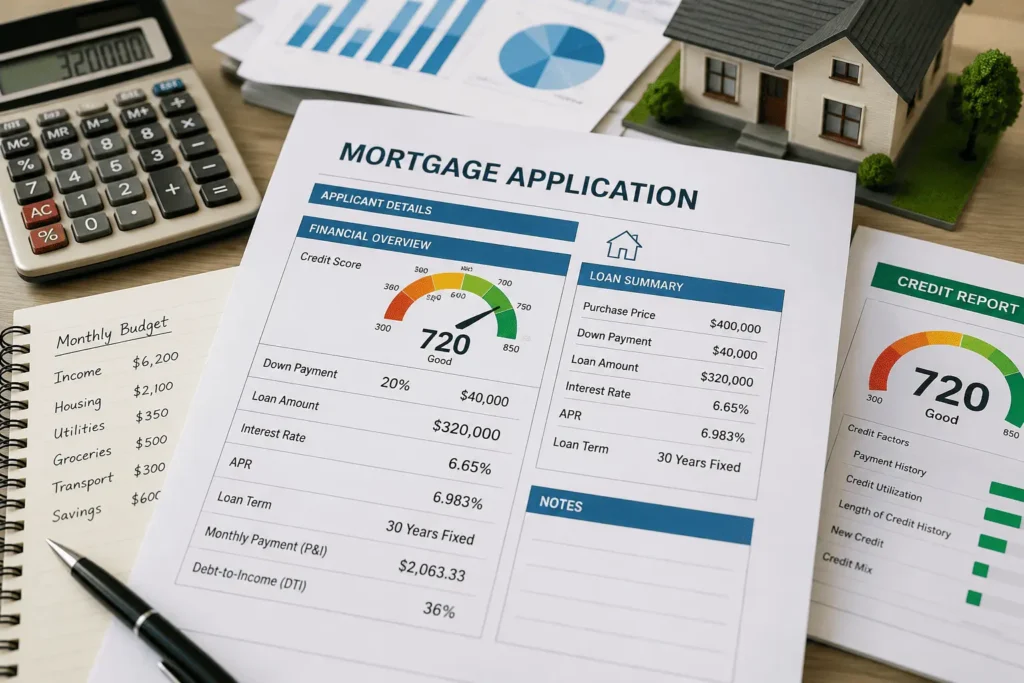
Your personal rate starts with the market, then gets adjusted for you. Lenders begin with the base price for your loan program on that day. Then they add or subtract based on your file.
The main adjusters are:
- Credit score and credit history depth
- Down payment size, measured as loan-to-value
- Debt-to-income ratio
- Property type and occupancy
- Loan amount and loan term
- Discount points you choose to buy
What moves mortgage rates: the Fed, inflation and the 10-year Treasury
Lenders call these adjustments loan level price adjustments. Each one is a small fee expressed as a rate bump. Two borrowers with identical incomes can be quoted differently because one is buying a condo and the other a single-family house. Ask any lender to explain which adjustments applied to your quote.
The Fed does not set mortgage rates. It sets the overnight rate banks charge each other. Mortgage rates track the 10-year Treasury yield instead, because both are long-term bets on inflation.
When investors expect inflation to rise, they demand higher yields, and mortgage rates climb. VA rates in particular are tied to the 10-year Treasury yield, which has risen since the start of 2026. This is why a Fed cut sometimes moves mortgage rates barely at all. Bond market reaction matters more than the announcement itself.
How your credit score changes your rate
Credit score is the single biggest lever you control. Lenders price in tiers, and each tier down costs you real money. A borrower at 760 and a borrower at 640 can be quoted rates half a percent apart on the same loan.
Rough tiers look like this:
- 760 and above: best available pricing
- 700 to 759: small bump, often 0.125% to 0.25%
- 660 to 699: noticeable bump, plus stricter terms
- Below 660: FHA usually beats conventional
Moving up one tier before you apply is often faster than saving a bigger down payment.
How to get a lower mortgage rate
Lowering your rate is not one move. It is four or five small ones stacked together. Each shaves off a fraction, and the total adds up.
Start with these:
- Pay down revolving balances 45 days before you apply
- Increase your down payment to cross the 20% line
- Choose a 15-year term if the payment fits
- Ask about lender credits and fee waivers
- Check whether the best first time home buyer programs in Indiana offer a below-market rate you qualify for
Order matters here. Fix your credit and your balances first, because those changes take weeks to show up. Handle the down payment and loan term next, since those are decisions you can make in a day. Save the points question for last, once you know your real rate.
Discount points and temporary buydowns
Points are prepaid interest. One mortgage point equals about 1% of your loan amount, so on a $250,000 loan a single point costs roughly $2,500. In return your rate drops, usually about 0.25% per point.
Points only pay off if you stay long enough. Divide the cost by the monthly savings to find your break-even month. A temporary buydown works differently. A 2-1 buydown cuts your rate by 2% in year one and 1% in year two, then returns to the note rate.
When to lock your mortgage rate
A rate lock freezes your quote for a set window, usually 30 to 60 days. Once locked, market moves cannot hurt you. They also cannot help you, unless your lock includes a float-down option.
Lock when you have a signed purchase contract and a closing date you trust. Locking too early risks paying an extension fee. Ask two questions before you agree: how many days does the lock run, and what does an extension cost per day.
What today’s mortgage rates mean for your monthly payment
Percentages feel abstract until you turn them into dollars. On a $300,000 loan, the difference between 6.30% and 6.80% is about $98 a month. Across 30 years that is roughly $35,000 in extra interest.
Run your own numbers before you talk to any lender. Our manufactured home payment calculator is useful if you are financing that property type, where standard tools often mislead. Remember that principal and interest is only part of the bill.
Your full monthly payment usually includes:
- Principal and interest
- Property taxes
- Homeowners insurance
- Mortgage insurance, if required
- HOA dues, if your neighborhood charges them
Scale that math up and it gets serious. On a $400,000 loan, a half-point difference costs about $131 a month, or nearly $1,600 a year. That is the same as a small car payment for three decades. Understanding mortgage rates today in dollar terms is what turns a confusing quote into a clear decision.
Taxes and insurance typically flow through an escrow account. If your loan is later transferred, a company such as PHH mortgage services may end up managing that account for you.
Why compare mortgage rates from multiple lenders?
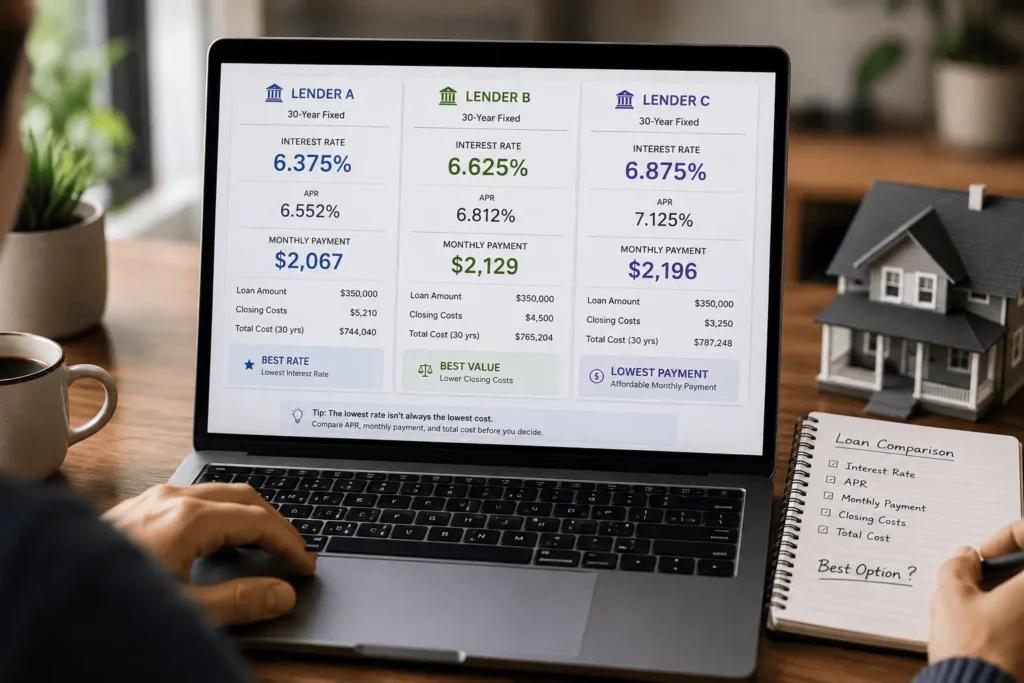
Because the savings are large and the effort is small. Freddie Mac research shows that in a high-rate market, homebuyers may save $600 to $1,200 a year by applying with multiple mortgage lenders. That is money you keep for doing an afternoon of work.
There is a second benefit most buyers miss. A competing offer is leverage, not just information. Once a lender knows you hold a better Loan Estimate, fees often disappear from the quote. Nothing else in the process gives you that much bargaining power for so little effort.
Lenders price differently based on their funding costs, volume goals, and appetite for your file. A credit union may beat a national bank on a conventional loan and lose badly on a jumbo. Reviewing a specific lender first helps, and our look at CMG Mortgage shows what that kind of research turns up.
How to compare mortgage rates
Compare quotes on the same day, for the same loan amount, term, and down payment. Rates move daily, so a Monday quote against a Thursday quote tells you nothing useful. Ask each lender for a Loan Estimate, which uses a standard federal format.
Then line up page one of each estimate side by side. Check the rate, the points charged, the origination fee, and the cash needed to close. A guide like our Flat Branch Mortgage review shows what to look for when you weigh one lender against another. Comparing mortgage rates today across three or four lenders is the single highest-paid hour in the whole home buying process.
APR vs. interest rate
The interest rate sets your monthly payment. The APR shows the total yearly cost including most lender fees. Because APR reflects interest plus fees, it is typically slightly higher than the interest rate alone.
Use both numbers together. A low rate with a high APR means heavy fees are hiding in the quote. A small gap between the two usually signals a cleaner offer. If the gap is wide, ask the lender to itemize what created it.
Different types of mortgage loans
Choosing the right loan type often saves more than negotiating a lower rate. These four comparisons cover almost every decision you will face.
Purchase loans vs. refinance loans
A purchase loan funds a home you are buying. A refinance replaces a loan you already have. Purchase loans usually price slightly lower and close faster.
Refinances split into two kinds. A rate-and-term refinance changes only your rate or payoff period. A cash-out refinance also pulls equity out, and it carries a higher rate.
Conventional loans vs. government-backed loans
Conventional loans follow Fannie Mae and Freddie Mac rules with no agency insurance behind them. FHA, VA and USDA loans are insured by the government, which encourages lenders to offer them and often means lower interest rates, though each carries its own fees and qualification rules.
Strong credit and 20% down usually favors conventional. Thinner credit or a small down payment usually favors FHA. Military service almost always favors VA.
Conforming loans vs. non-conforming loans
A conforming loan stays within the FHFA limit and follows agency guidelines. Anything outside those lines is non-conforming, and jumbo is the most common example.
Non-conforming does not mean risky. It means the loan cannot be sold to Fannie or Freddie, so the lender holds more risk and prices accordingly. Most buyers never cross that line, so conforming rules will shape almost every quote you receive.
Fixed-rate loans vs. adjustable-rate loans
A fixed rate never changes for the life of the loan. An ARM starts lower in most markets, then adjusts on a set schedule with caps limiting each move.
Pick fixed if you plan to stay more than seven years or if a rising payment would strain your budget. Pick an ARM only when the starting rate is meaningfully lower and your timeline is short.
How we track today’s mortgage rates
Our numbers come from published daily and weekly surveys, including Freddie Mac’s Primary Mortgage Market Survey, Bankrate’s lender survey, and Mortgage News Daily’s index. We update figures on business days and note the date on every number we publish.
We also separate two things that often get mixed up. Daily trackers show where mortgage rates today are moving in real time, while weekly surveys smooth the noise and show the broader trend. Both are useful, but they answer different questions. Use daily numbers to time a lock and weekly numbers to judge the market.
Survey averages assume a standard borrower profile. That usually means a credit score near 740, a 20% down payment, a single-family primary residence, and a conforming loan amount. Your quote will differ if your file differs, which is why we always tell readers to compare live Loan Estimates rather than rely on any published average.
Conclusion
At the start of this guide, we promised that you would finish reading a rate quote the way a loan officer reads one. You now know what mortgage rates today look like across every major program, what moves them week to week, and which levers actually lower your number. The next step is small and it pays well: collect three Loan Estimates on the same day and put page one of each side by side. That single hour is usually worth more than months of waiting for a better market.
Frequently asked questions
How often do mortgage rates change during the day?
Lenders can reprice more than once in a single day. Most publish morning pricing, then adjust if the bond market moves sharply. On volatile days you may see two or three repricings before the market closes.
Can I negotiate the interest rate a lender quotes me?
Yes. Bring a competing Loan Estimate and ask the lender to match or beat it. Many will lower fees or apply a lender credit rather than lose your file, especially if your credit and down payment are strong.
Does shopping multiple lenders hurt my credit score?
Barely. Credit scoring models treat all mortgage inquiries made within a 45-day window as one single event. Shop as many lenders as you like inside that window without stacking up separate score penalties on your report.
Do free first time home buyer programs Indiana offers change my interest rate?
Sometimes. Certain assistance programs pair grants or forgivable second loans with a set first-mortgage rate. That rate can sit slightly above market, so compare the total benefit against a standard loan before choosing.
Can I switch lenders after I lock my rate?
Yes, a lock is not a binding contract to borrow. You can walk away and start over with another lender. You will lose any application or appraisal fees already paid, and your closing date will likely slip.