
Average Mortgage Rate Indiana: Your Complete Home Loan Guide for Smarter Savings
Picture yourself sitting at the kitchen table with two lender quotes in front of you. One says 6.5%. The other says 6.9%. Both promise you the “best deal,” and neither one explains why the numbers sit so far apart. That gap is not a typo, and you are not missing something obvious.
I have watched Hoosier buyers walk away from good homes because nobody sat them down and explained the numbers in plain words. So this guide does exactly that. You will learn what the average mortgage rate Indiana lenders offer really looks like today, which loan fits your situation, what down payment help you can claim, and how the state’s new property tax rules change your monthly bill. By the end, you will be able to read a rate sheet without guessing.
Current Indiana Mortgage Rates
Rates in the Hoosier State track the national market closely, but they are rarely identical. Local lender competition, county property taxes, and loan size all push your final number up or down. The average mortgage rate Indiana borrowers actually receive depends heavily on credit score and down payment. Figures below reflect statewide averages reported in late July 2026.
Today’s 30-Year Fixed Mortgage Rate
The 30-year fixed sits between 6.69% and 6.87% depending on the data source. Bankrate reported 6.69% for Indiana in early July, while Experian’s Curinos data showed 6.87% for a 720 credit score. Forbes Advisor listed the APR at 6.765% on July 30, and that is the average mortgage rate Indiana buyers see quoted most often.
Today’s 15-Year Fixed Mortgage Rate
Fifteen-year loans run roughly 5.95% to 6.06% in Indiana. You pay more each month but save a large amount in total interest.
Today’s 20-Year & 10-Year Fixed Rates
These terms sit between the 30-year and 15-year. Indiana 20-year loans hover near 6.50%, and 10-year loans near 5.38%.
Today’s FHA Mortgage Rates
FHA rates in Indiana average around 5.75% to 6.29%. The note rate looks lower than conventional, but mortgage insurance raises your real cost, so compare APR.
Today’s VA Mortgage Rates
VA loans price near 5.91% to 6.35% statewide. There is no monthly mortgage insurance, which makes the payment lighter than the rate alone suggests.
Today’s USDA Mortgage Rates
USDA rates usually land close to FHA pricing. Because the guarantee fee is small, the total cost is often the cheapest zero-down option.
Today’s Jumbo Mortgage Rates
Indiana jumbo loans average about 6.77% APR. Jumbo pricing is sometimes lower than conventional because these borrowers bring strong credit and large reserves.
Today’s ARM Mortgage Rates (5/1, 7/1, 10/1)
Adjustable loans start near 6.34% to 6.48% for a five-year term. Seven-year and ten-year ARMs price a little higher.
Today’s Indiana Refinance Rates
Refinance pricing runs slightly above purchase pricing. The 30-year refinance averages about 6.80% to 7.04%, and the 15-year refinance about 5.91% to 6.13%.
How We Source These Rates
We pull statewide averages from published lender surveys and rate-engine data, then cross-check them against multiple providers before publishing. Every average mortgage rate Indiana figure on this page assumes a single-family primary residence, 20% down, and a 720 FICO score. Your personal quote will differ. Questions about a specific scenario can go to james@allthings-mortgage.com.
Indiana Mortgage Rate Trends
Watching the direction of rates matters more than watching any single day’s number. The average mortgage rate Indiana buyers see has moved in a fairly narrow band through most of 2026.
Indiana vs National Mortgage Rates
Indiana pricing sits within a few hundredths of a point of the national figure. Forbes Advisor put the state at 6.765% against a national 6.771%. Experian showed the state running two basis points below the national number. In short, the average mortgage rate Indiana reports is essentially the national rate with a small local discount.
30-Day, 90-Day & 1-Year Rate Movement
Rates climbed roughly 0.30 points over the last 90 days and about 0.29 points over the last 30 days. Compared with a year ago, the 30-year fixed is roughly 50 basis points lower.
Historical Mortgage Rate Trends (5Y / 10Y)
Rates have stayed above 6% for most of the past two years, and often above 7%. Before 2022, the average mortgage rate Indiana buyers locked in regularly sat in the 3% range.
Indiana Mortgage Rate Forecast for 2026
Most forecasters expect modest declines heading into next year. Almost none expect a return below 6%. Build your budget around the average mortgage rate Indiana lenders quote today, not a hoped-for future one.
Mortgage Rates by Indiana City
Statewide averages hide real local differences. Home prices, tax districts, and lender density all shift your effective cost by metro. The average mortgage rate Indiana publishes statewide will not match every county.
Indianapolis & Marion County
Indianapolis has the deepest lender pool in the state, so rate shopping pays off most here. Marion County tax rates run high, which pushes many homesteads to the 1% property tax cap. That cap actually protects buyers in high-rate districts.
Fort Wayne & South Bend
Both markets offer lower entry prices than the Indy metro. Local credit unions and regional banks compete hard, and their pricing often beats national online lenders.
Carmel, Fishers & Hamilton County
Hamilton County carries the state’s highest median home values. More buyers here cross into jumbo territory or need larger down payments.
Evansville, Bloomington & Lafayette
These are strong first-purchase markets with steady inventory. Evansville runs its own neighborhood assistance program, and college-town demand keeps Bloomington and Lafayette steady.
Gary, Hammond & Northwest Indiana
Northwest Indiana borrowers often shop Chicago-area lenders too. Local tax rates rank among the highest in the state, so the 1% homestead cap does heavy lifting here.
Mortgage Loan Types in Indiana
Choosing the wrong loan type costs more than choosing the wrong lender. Here is how each option actually works in practice.
Conventional Loans
You need a 620 credit score minimum and a debt-to-income ratio under 45% at most lenders. Put less than 20% down and you pay private mortgage insurance until you reach 20% equity.
FHA Loans
FHA allows 3.5% down with a 580 score, or 10% down with a score as low as 500. Mortgage insurance usually lasts the life of the loan, but it is the most forgiving option for damaged credit.
VA Loans
Active-duty members, veterans, and surviving spouses can borrow with zero down and no monthly mortgage insurance. There is no maximum loan amount if you hold full entitlement.
USDA Loans (Which Indiana Areas Qualify)
Large parts of Indiana outside the Indianapolis, Fort Wayne, and Northwest Indiana metros qualify as rural. Check the USDA eligibility map by street address, not by county name.
Jumbo Loans
Anything above the conforming limit becomes a jumbo loan. Expect a 700-plus credit score, 10% to 20% down, and several months of reserves.
Adjustable-Rate Mortgages (ARM)
An ARM locks your rate for a set period, then adjusts on a schedule. Ask for the caps — the first adjustment cap, the periodic cap, and the lifetime cap.
Manufactured & Modular Home Loans
Manufactured housing is common across rural Indiana, and financing rules differ sharply from site-built homes. Loan terms are shorter and rates run higher, especially on chattel loans. Our 21st Mortgage review breaks down how one of the largest manufactured home lenders prices these deals.
New Construction & Renovation Loans
Construction-to-permanent loans fund the build, then convert to a standard mortgage. FHA 203(k) and Fannie Mae HomeStyle loans let you finance repairs into the purchase.
Assumable FHA & VA Loans in Indiana
If a seller holds an FHA or VA loan from 2020 or 2021, you may be able to assume their low rate. You still must qualify, and you must cover the seller’s equity in cash or a second loan.
Indiana Loan Limits by County (2026)
Conforming Loan Limits
The baseline conforming limit for 2026 is $832,750 for a one-unit property. Every Indiana county uses the baseline figure, since none carry a high-cost designation.
FHA Loan Limits by County
FHA limits are lower and vary by county. Most Indiana counties use the FHA floor, while Indianapolis-area counties carry higher limits.
When You Cross Into Jumbo Territory
Purchase price is not the trigger — loan amount is. A $900,000 home with 20% down leaves a $720,000 loan, which stays conforming.
Indiana First-Time Home Buyer Programs

This is where most buyers leave money on the table. The state runs several assistance programs, and layering them correctly can cut your cash-to-close by thousands. If you are an Indiana first time home buyer, read this section twice.
IHCDA First Step (5% Down Payment Assistance)
First Step provides down payment assistance equal to 5% of the purchase price. It pairs with FHA or conventional first mortgages through approved lenders. Many first time home buyers Indiana works with use this as their primary source of down payment funds.
IHCDA Next Home (2.5%–3.5% DPA)
Next Home offers 2.5% or 3.5% of the purchase price in assistance. It is often the fallback when a borrower does not qualify for First Step. A first-time home buyer Indiana lenders classify as a repeat buyer may still qualify in a targeted area.
IHCDA Step Down (Rate-Only Program)
Step Down gives a reduced interest rate with no down payment assistance attached. It suits buyers who already have savings but want a lower monthly payment. For a first time home buyer in Indiana with gift funds available, this is often the cheapest long-run option.
IHCDA Next Step (Refinance Option)
Next Step is a one-time refinance opportunity for existing IHCDA First Place and First Step borrowers. It exists so program participants are not locked into an above-market rate forever.
Mortgage Credit Certificate (MCC)
An MCC converts part of your annual mortgage interest into a dollar-for-dollar federal tax credit. It is claimed every year you live in the home, not just once. Indiana first time home buyers should keep their Form 1098 mortgage interest statement safe, since the credit is calculated from it.
FHLBank Indianapolis HOP & HomeBoost
The Homeownership Opportunities Program provides up to $20,000 in assistance through member banks, capped at 80% of area median income. HomeBoost is separate and targets first-generation buyers earning up to 120% AMI. Both run first-come, first-served, so first time home buyers in Indiana should apply early in the funding round.
City & County Programs (Indianapolis, Evansville, Gary, Fort Wayne)
Evansville offers up to $7,500 as a 0% deferred loan in designated neighborhoods, forgiven after five years. Gary’s Homeownership Opportunity Network provides up to $5,000. Any Indiana first-time home buyer should call their city housing department before assuming statewide programs are the only option.
Employer-Assisted & Nonprofit Programs
Some Indiana hospitals, universities, and manufacturers offer housing grants to employees. Nonprofits and HUD-approved counselors track programs that never get advertised publicly.
Eligibility Requirements
Most Indiana first-time home buyer programs share the same core rules. Meeting them is straightforward once you know the thresholds.
- Credit score: 660 minimum for DTI up to 45%; 680 minimum for DTI between 45% and 50%
- First-time definition: no ownership interest in a primary residence during the past three years
- Exemptions: veterans and buyers in federally targeted areas are usually exempt from the first-time rule
- Income limits: vary by county and by household size
- Purchase price limits: each county carries its own acquisition cap
- Lender: must be an IHCDA-approved participating lender
Homebuyer Education Requirement
Nearly every assistance program requires a completed homebuyer education course. Your certificate is what unlocks first time home buyer finance options at closing.
What Is the Recapture Tax?
Some grant-style assistance carries a federal recapture provision. If you sell within nine years, and your income has risen sharply, and you made a gain on the sale, part of the benefit may be owed back as tax. All three conditions must be true, which is why very few borrowers ever pay it.
How to Apply & Find an Approved Lender
Start by contacting an IHCDA-approved lender, not the agency itself. Reserve your funds before you go under contract, since allocations are limited. If you want a second opinion on which program fits your file, email james@allthings-mortgage.com with your county and household size.
Indiana Down Payment Assistance Programs Compared
| Program | Assistance Amount | Min. Credit Score | Structure | Repayment |
| IHCDA First Step | 5% of purchase price | 660 | Second mortgage | Repaid on sale or refinance |
| IHCDA Next Home | 2.5% or 3.5% | 660 | Forgivable second | Forgiven after 2 years |
| IHCDA Step Down | Rate reduction only | 660 | Below-market first mortgage | None |
| FHLBI HOP | Up to $20,000 | Lender-set | Grant | Forgiven over retention period |
| FHLBI HomeBoost | Varies (first-generation) | Lender-set | Grant | Forgiven over retention period |
| Evansville Neighborhood | Up to $7,500 | 620 | Deferred 0% loan | Forgiven after 5 years |
| Gary HON | Up to $5,000 | Program-set | Assistance loan | Program terms apply |
Indiana Property Taxes & Your Monthly Payment (2026 SEA 1 Changes)
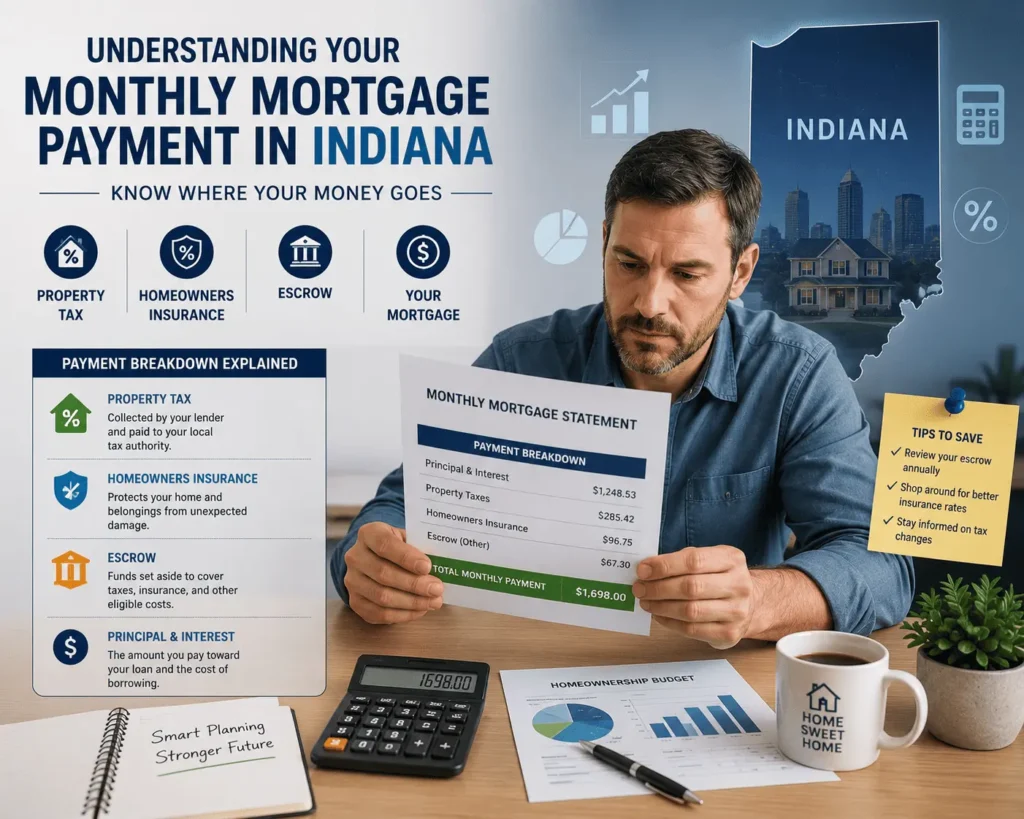
Almost no national rate page explains this, and it directly changes what you pay each month. Indiana rewrote its property tax rules in 2025, and 2026 bills are the first to reflect them.
How Indiana Calculates Property Tax
Start with your home’s gross assessed value. Subtract the homestead deductions to get net assessed value. Multiply that by your local tax district rate, then apply credits and caps.
Homestead Standard & Supplemental Deductions
For 2026 bills, homeowners still receive the $48,000 standard homestead deduction. The supplemental deduction rose from 37.5% to 40% of the remaining assessed value.
The New 10% / $300 Homestead Tax Credit
Senate Enrolled Act 1 created a new credit worth the lesser of 10% of your bill or $300. No application is needed, since your county auditor applies it automatically. It lands after the circuit breaker and all other credits.
The 1%–2%–3% Circuit Breaker Cap
Indiana’s constitution caps property tax at 1% of gross assessed value for a primary residence. Rental and agricultural property is capped at 2%, and commercial at 3%.
What SEA 1 Changes Through 2031
The standard deduction shrinks each year while the supplemental percentage climbs toward 66.7% by 2031. Roughly two-thirds of Hoosier homeowners are expected to see a lower 2026 bill than 2025.
Relief for Seniors, Veterans & Disabled Homeowners
SEA 1 converted several deductions into credits, so relief now applies even when a bill already sits at the cap. The Over-65 Circuit Breaker income limit rose to $60,000 single and $70,000 joint. Older homeowners exploring equity options can also review how a reverse mortgage account is managed before deciding.
What Your Real Monthly Payment Looks Like
Principal & Interest vs Full PITI
Every rate table you see online shows principal and interest only. Your real bill adds property taxes, homeowners insurance, and often mortgage insurance. That gap commonly runs $300 to $600 per month in Indiana.
Average Homeowners Insurance Cost in Indiana
Indiana premiums run below the national average, helped by moderate home values. Wind, hail, and older roofs are the biggest cost drivers. Coverage rules and escrow requirements are explained in our guide to homeowners insurance requirements before closing.
PMI, MIP & VA Funding Fee Costs
Conventional PMI generally costs 0.3% to 1.5% of the loan amount per year. FHA charges both an upfront and an annual premium, while VA charges a one-time funding fee instead.
HOA Fees in Indiana Communities
Newer subdivisions in Hamilton and Hendricks counties commonly carry HOA dues. Lenders count these dues in your debt-to-income ratio, so ask for the amount before you offer.
Indiana Housing Market Overview
Median Home Prices (Statewide & by Metro)
Indiana’s median sale price has been running around $254,000 to $260,000, well below the national median. Hamilton County sits far above that figure, while northwest and southern Indiana sit below it.
Housing Inventory & Days on Market
Homes have been sitting roughly 33 days on the market on average. Inventory has grown since the pandemic years, which gives buyers more room to negotiate.
Homes Selling Above/Below List Price
About 18.5% of Indiana homes sold above list price recently, while roughly 40.9% saw a price drop before selling. Those two numbers together tell you the market has cooled.
Income Needed to Buy a Home in Indiana
A buyer needs roughly $72,000 in annual household income to keep a typical Indiana mortgage payment under 30% of monthly income. That figure runs higher in Indianapolis and Hamilton County.
Indiana Affordability vs Neighboring States
Indiana remains cheaper than Illinois and Michigan on both price and property tax. The homeownership rate sits near 73.4%, one of the highest in the country.
Closing Costs in Indiana
Average Closing Costs for Indiana Buyers
Expect roughly 2% to 5% of the purchase price. On a $260,000 home, that means about $5,200 to $13,000.
Who Pays What (Buyer vs Seller)
Buyers typically cover the appraisal, credit report, origination, and prepaid escrow. Sellers usually pay the listing commission and owner’s title policy, though everything is negotiable.
Seller Concessions & How to Negotiate Them
Sellers can contribute toward your closing costs, subject to loan-type limits. In a slower market, asking for 2% to 3% is reasonable, and concessions can fund a rate buydown.
Ways to Reduce Your Closing Costs
- Compare Loan Estimates from at least three lenders on the same day
- Shop your own title company where state rules allow it
- Ask about lender credits in exchange for a slightly higher rate
- Close near month-end to reduce prepaid interest
- Apply assistance funds toward closing costs, not just the down payment
How to Get the Best Mortgage Rate in Indiana
Small moves here beat months of rate-watching. The average mortgage rate Indiana lenders quote is a starting point, never your final price.
Improve Your Credit Score
Moving from 660 to 740 can cut your rate by a quarter point or more. Pay revolving balances below 30% utilization, and avoid opening new accounts during your application.
Increase Your Down Payment
Crossing 20% removes PMI on a conventional loan. Even reaching 10% or 15% improves your pricing tier, and assistance funds count toward it.
Should You Buy Discount Points? (Break-Even Math)
One point costs 1% of the loan and typically lowers your rate by about 0.25%. Divide the point cost by your monthly savings to find your break-even month. If you plan to move or refinance before that month, skip the points.
Consider a Temporary Rate Buydown (2-1, 3-2-1)
A 2-1 buydown lowers your rate by 2% in year one and 1% in year two. Sellers often fund it instead of cutting the price, but you must still qualify at the full note rate.
Compare Multiple Lenders
Rate spreads between lenders on the same file are real and often large. Pull all quotes within a 45-day window so credit scoring treats them as one inquiry. Comparing three written offers is the fastest way to beat the average mortgage rate Indiana publishes. Reviewing how lenders structure offers — like this breakdown of choosing the right home loan — helps you spot which fees are negotiable.
Lock Your Interest Rate
Standard locks run 30, 45, or 60 days. Ask whether a float-down option is available, and note that extension fees apply if closing slips.
Best Mortgage Lenders in Indiana
Indiana Banks
Old National Bank, First Merchants, 1st Source, and Centier all lend statewide. Regional banks often price competitively on jumbo and portfolio loans, and existing customers should ask about relationship pricing.
Indiana Credit Unions
Teachers Credit Union, Evansville Teachers Federal Credit Union, and Indiana Members Credit Union serve large membership bases. Credit unions frequently charge lower origination fees, and membership is usually easy to obtain.
Indiana-Based Mortgage Companies
Ruoff Mortgage and Interra Credit Union are well known across northern Indiana. Local companies often close faster because their underwriting sits in-state.
Online Mortgage Lenders
National online lenders compete hard on rate but vary widely on service. Some accept lower credit scores than local banks. Our look at CMG Mortgage for first-time and repeat buyers shows how to evaluate a lender beyond the advertised rate.
IHCDA-Approved Lenders
Only approved lenders can originate IHCDA assistance loans. The approved list is published by the agency and changes periodically, so confirm before you apply.
How to Compare Loan Estimates Side by Side
Line up page 2 of each Loan Estimate. Compare origination charges, discount points, and lender credits, and ignore third-party fees you cannot control. The bottom-line cash-to-close figure is your real comparison point. Also ask whether the lender retains servicing, since your loan may later be transferred to a servicer you did not choose.
Mortgage Calculators & Tools
Monthly Payment & Affordability Calculators
A payment calculator only helps if you add property tax, insurance, PMI, and HOA dues. Use Indiana’s 1% homestead cap as a safe tax estimate. For manufactured housing, a manufactured home payment calculator gives a far more accurate figure than a standard tool.
Refinance & Rent vs Buy Calculators
A refinance calculator divides your closing costs by monthly savings to show a break-even month. A rent vs buy tool compares total cost over your expected time in the home.
Should You Refinance Your Mortgage?
Refinancing makes sense less often than lenders suggest. Compare your existing note rate against the average mortgage rate Indiana lenders quote today before you pay for an appraisal.
When Refinancing Makes Sense (Break-Even Formula)
Divide total refinance costs by your monthly savings. That gives you the number of months to break even, and moving sooner means you should not refinance.
Cash-Out Refinance & Indiana Home Equity
Indiana home values have risen steadily, and many owners hold significant equity. A cash-out refinance trades your low rate for cash, which is expensive if your current rate is under 4%, so a HELOC often costs less.
Streamline Refinance: FHA & VA IRRRL
FHA Streamline and VA IRRRL loans skip the appraisal and most income documentation. They only work when you already hold that loan type, and closing costs are lower.
Common Mistakes Indiana Home Buyers Make
- Shopping only one lender and assuming the rate is standard
- Budgeting for principal and interest while ignoring taxes and insurance
- Missing the assistance reservation deadline by going under contract too early
- Assuming a 20% down payment is required
- Opening a credit card or financing furniture during underwriting
- Skipping the homebuyer education course and losing program eligibility
- Forgetting that paying extra toward your mortgage after closing can cut years off the loan
- Never checking whether their monthly payment options include free autodraft
Frequently Asked Questions
What credit score do I need to buy a house in Indiana?
Conventional loans generally require 620, FHA accepts 580 with 3.5% down, and state assistance programs require 660 minimum. A score of 740 or higher unlocks the best pricing tier and can lower your rate by roughly a quarter point.
How much down payment do I need in Indiana?
Conventional loans start at 3% down and FHA at 3.5%. VA and USDA loans require zero down. State assistance can cover 2.5% to 5% of the purchase price, and grants may add up to $20,000 more.
Are Indiana mortgage rates higher than the national average?
No. The average mortgage rate Indiana reports typically sits within a few hundredths of a percentage point of the national figure, and often slightly below it. Recent data showed the state running two to six basis points under the national 30-year rate.
Do I have to repay down payment assistance in Indiana?
It depends on the program. First Step assistance is repaid when you sell or refinance. Next Home, FHLBI grants, and the Evansville program are forgiven after a set occupancy period, usually two to five years.
How does Indiana’s 1% property tax cap affect my mortgage payment?
Your homestead property tax bill cannot exceed 1% of gross assessed value. On a $250,000 assessed home, that caps taxes at $2,500 yearly, or about $208 monthly in escrow, which is a reliable number for budgeting your payment.